In her recent piece published in
ATS Scholar, Medha Cherabuddi reflects on the role of art, technology, and human connection in medicine.
Between ICU rounds, admissions, and teaching, Medha found a moment to talk about this part of her life, one that long predates her medical training.
She took formal art classes as a child, beginning in elementary school, moving in and out of instruction as other demands took over. It was never a straight progression toward becoming an artist, nor did it disappear when medicine entered the picture. Instead, it resurfaced at different moments and in different forms.
Her parents, both engineers who live in India, did not imagine art as a career path. Education, however, was central. Both of her grandfathers were teachers, shaping her interest in explanation and learning. Art, she admits, is harder to account for. “I know where I got my love for teaching from,” she said. “But art—I’m actually not quite sure.”
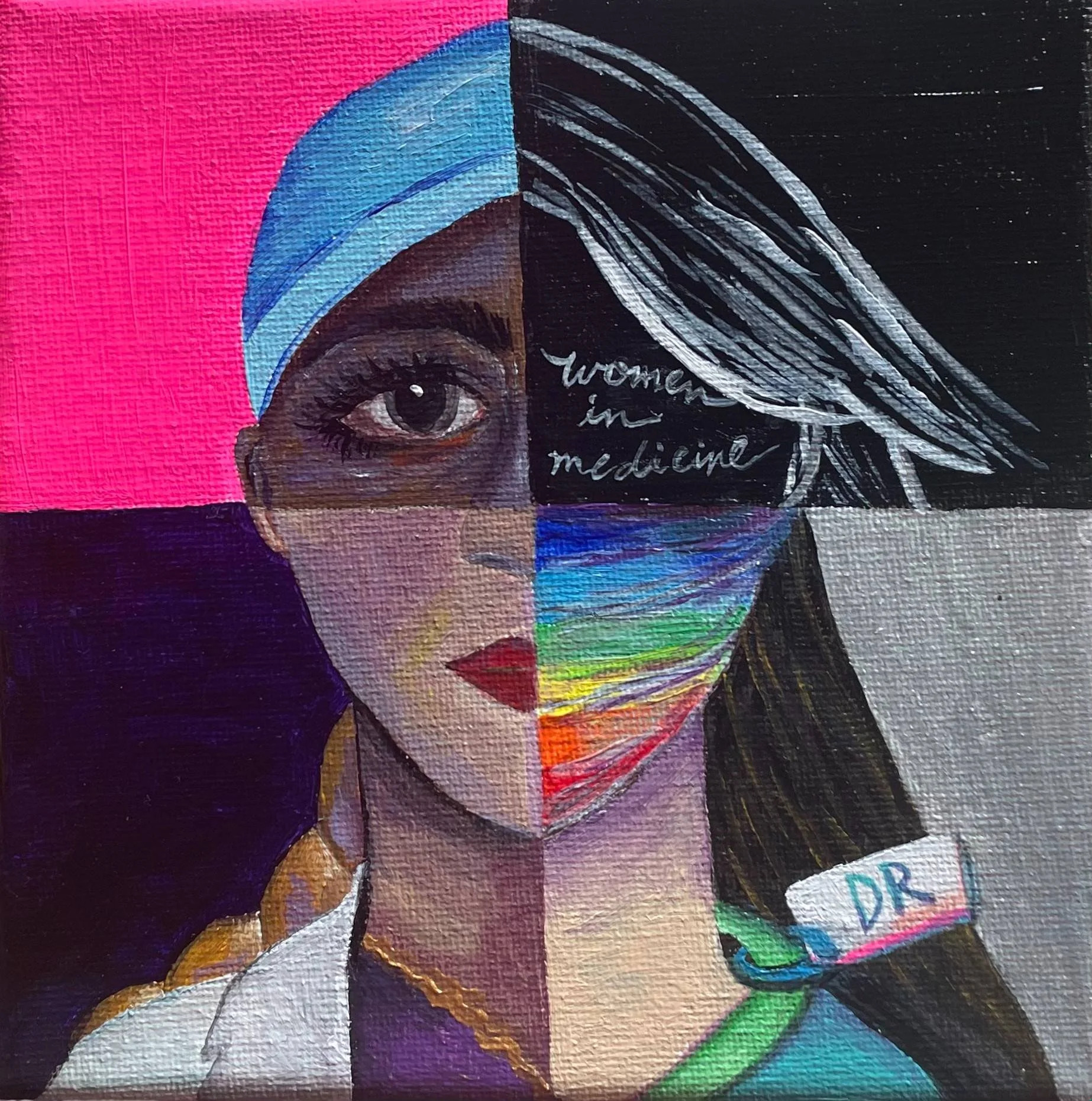
During medical school, she returned to painting more deliberately, working in oils. What began as a way to step away from the demands of training gradually became part of how she understood herself as a clinician. When she applied for fellowship, she included a hyperlink to one of her paintings in her personal statement—an unconventional choice underscoring her view that creative work and critical care were not separate pursuits. “You can’t just do the same thing for everyone,” she said.
“There’s a lot of big-picture thinking.”
That perspective carried naturally into pulmonary and critical care. Patients often arrive with the same limited set of symptoms—shortness of breath, cough, wheezing—but Medha found herself increasingly drawn to what lay beneath those presentations. “Everyone comes in with the same symptoms,” she said, “but the thing that’s different is their story.” Understanding those stories requires the same patience and interpretive work that art does.
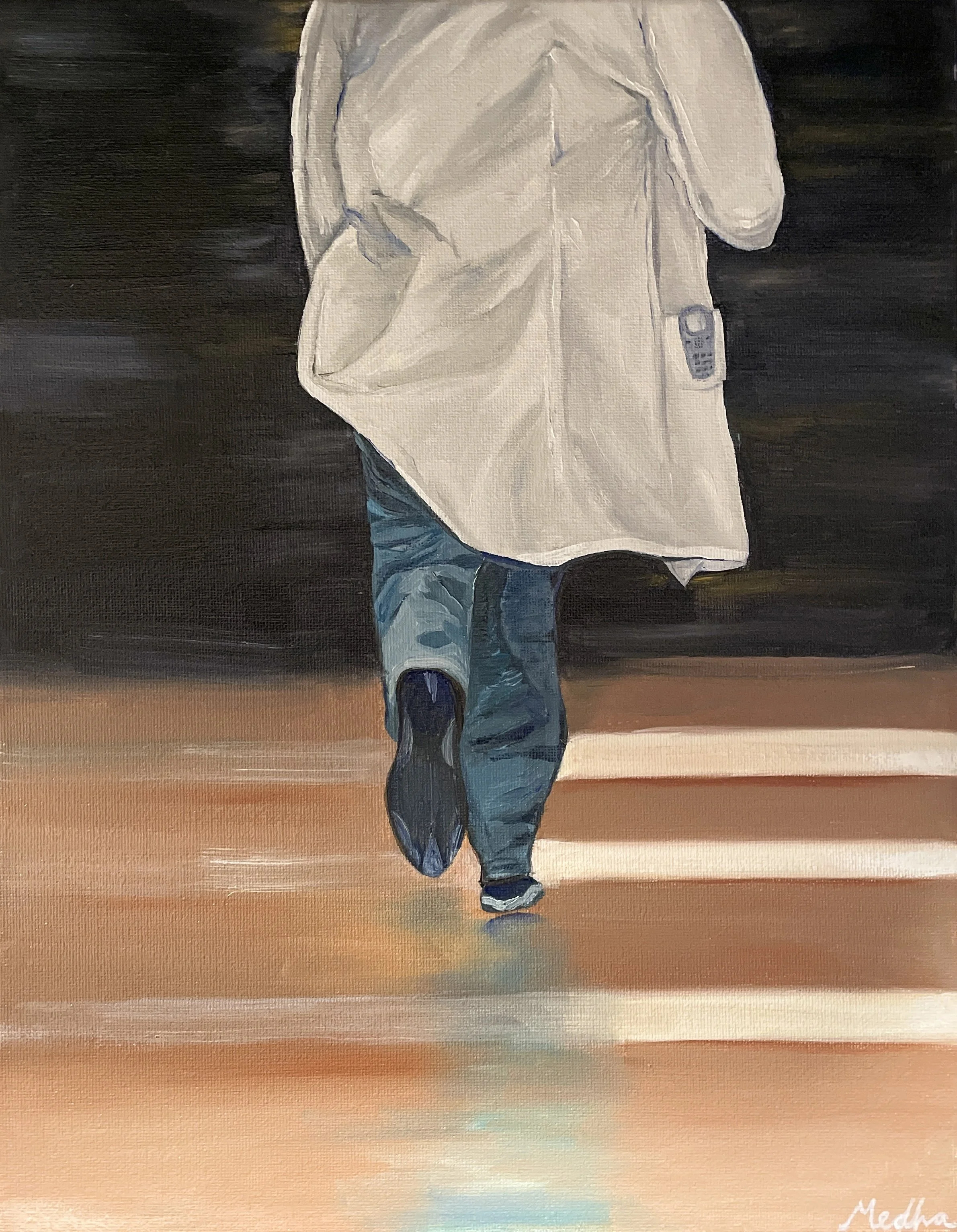
Her paintings began to reflect those parallels. One piece from residency depicts clinicians running toward a code, a bright light at the end of a corridor. At first glance, it reads as urgency. Over time, its meaning shifted. What initially appeared to be about speed became a meditation on pacing and endurance. Created toward the end of residency, the piece reflected a period of fatigue and uncertainty. “You’re running every day,” she said, “but you also have to think about how long you can keep going.”
“Patients often come in with similar symptoms. What’s different is their story—and piecing that together takes time.”
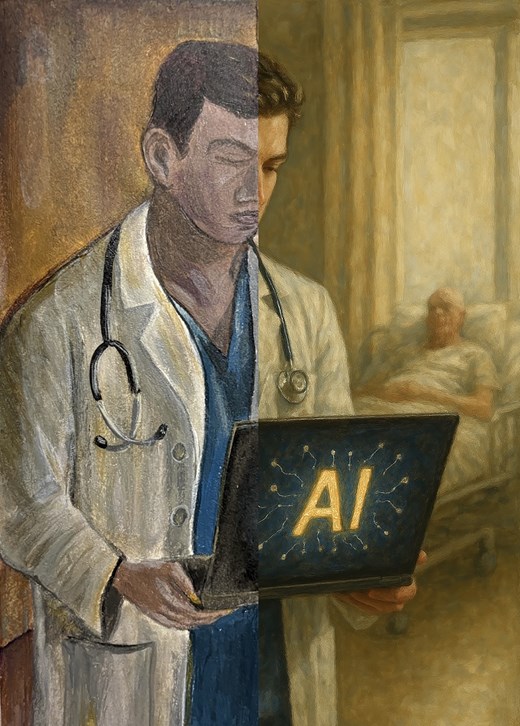
Her most recent work turns outward, toward education and technology. The ATS Scholar piece emerged during her time teaching in the ICU and NICU as a fellow, when she noticed a generational shift among learners. Many had trained almost entirely in a post-COVID environment. “A lot of residents and students had only known that world,” she said.
Her aim was not to argue against technology, but to think carefully about its role. “We should collaborate with technology rather than depend on it,” she said. She has already seen AI-generated images become commonplace in presentations, efficient but flattening. “Before, you had to work with an image to make it fit,” she said. “Now it’s just there.”
Art, for her, resists that ease. It demands attention and tolerates uncertainty. In medicine, that translates to presence—time at the bedside, attention to how patients experience care, and an insistence on staying engaged with the human dimensions of illness. “For the creative and humane part of medicine,” she said, “we have to be careful not to lose that.”
Despite a demanding schedule, she continues to make art, often late at night and in smaller increments than before. Time no longer allows for long, uninterrupted sessions, and her work has adapted accordingly. “Everything I’ve done since residency has been smaller pieces,” she said. She recently began a larger painting and expects it to take time. That feels appropriate.
Asked what she would tell trainees who feel creatively inclined, her advice is practical.Medicine is consuming, and everyone needs something beyond their clinical work. If art matters to you, she suggests, make space for it—but let it change shape. “It’s going to look like a new normal,” she said. Smaller projects. Manageable goals. Continuity over scale.
Art, for Medha, was never a diversion from medicine. It has run alongside it, quietly shaping how she listens, teaches, and practices. It is part of the same work.
