Pulmonary & Critical Care Division Newsletter

February 2026

Welcome to the February 2026 edition of our division newsletter. Below you’ll find updates from each department including research highlights, clinical news, social updates, and more.

Your Vote Shapes How Our Hospital Is Seen Nationwide

Overview

The U.S. News & World Report physician reputation survey will be distributed through Doximity between mid-February and mid-March. To receive the survey, physicians must have an active Doximity account.
We are asking all physicians to open or log into Doximity by next week to ensure their profile information is current. When the survey email arrives, please submit your vote for Henry Ford Hospital — Detroit. Physician participation directly influences national reputation rankings.

Inside the Pulmonary Division

The Art of Paying Attention: On Meddha Cherabuddi’s ATS Scholar publication


In her recent piece published in
ATS Scholar, Medha Cherabuddi reflects on the role of art, technology, and human connection in medicine.
Between ICU rounds, admissions, and teaching, Medha found a moment to talk about this part of her life, one that long predates her medical training.
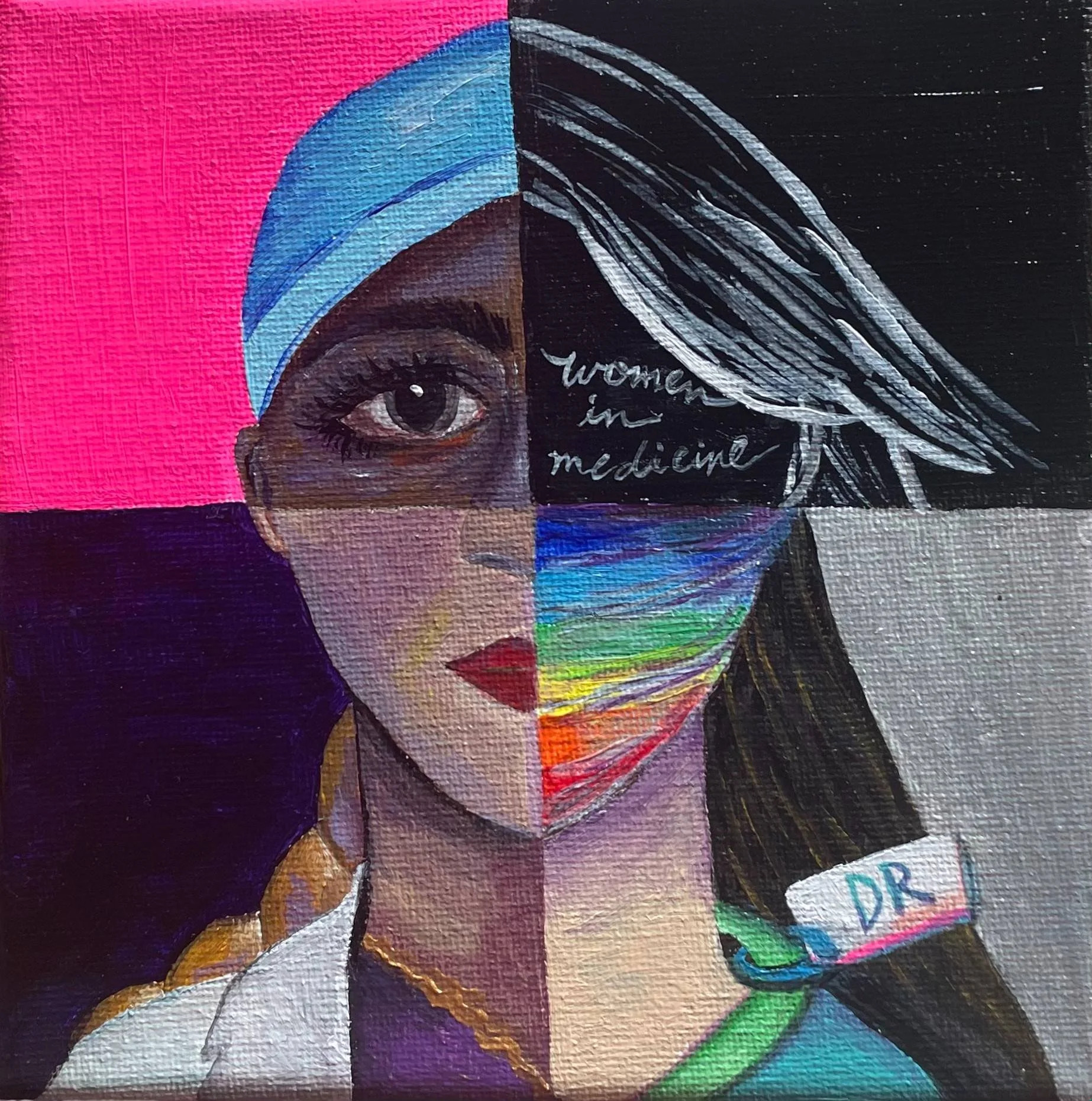
She took formal art classes as a child, beginning in elementary school, moving in and out of instruction as other demands took over. It was never a straight progression toward becoming an artist, nor did it disappear when medicine entered the picture. Instead, it resurfaced at different moments and in different forms.

Her parents, both engineers who live in India, did not imagine art as a career path. Education, however, was central. Both of her grandfathers were teachers, shaping her interest in explanation and learning. Art, she admits, is harder to account for. “I know where I got my love for teaching from,” she said. “But art—I’m actually not quite sure.”

During medical school, she returned to painting more deliberately, working in oils. What began as a way to step away from the demands of training gradually became part of how she understood herself as a clinician. When she applied for fellowship, she included a hyperlink to one of her paintings in her personal statement—an unconventional choice underscoring her view that creative work and critical care were not separate pursuits. “You can’t just do the same thing for everyone,” she said. “There’s a lot of big-picture thinking.”
That perspective carried naturally into pulmonary and critical care. Patients often arrive with the same limited set of symptoms—shortness of breath, cough, wheezing—but Medha found herself increasingly drawn to what lay beneath those presentations. “Everyone comes in with the same symptoms,” she said, “but the thing that’s different is their story.” Understanding those stories requires the same patience and interpretive work that art does.


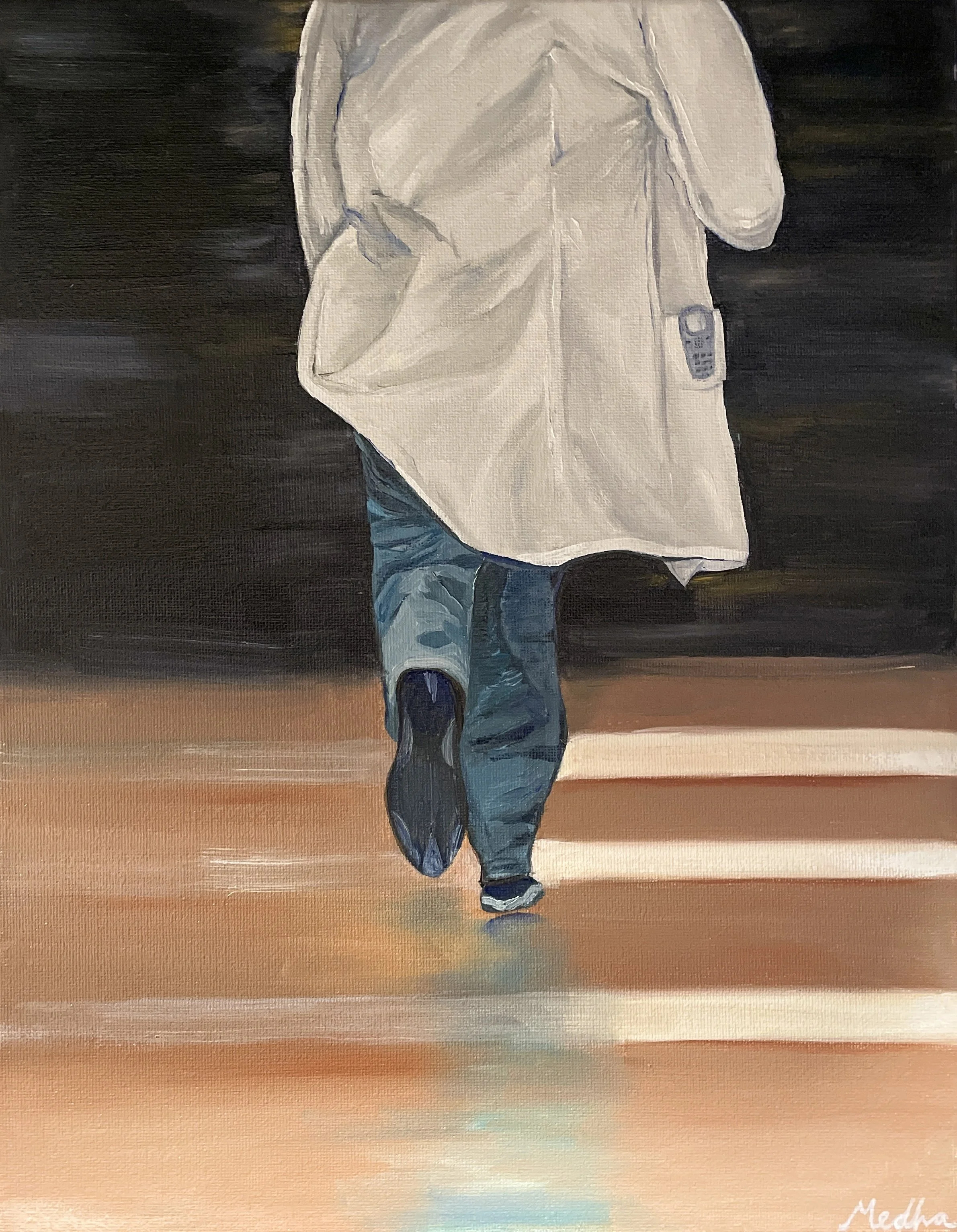
Her paintings began to reflect those parallels. One piece from residency depicts clinicians running toward a code, a bright light at the end of a corridor. At first glance, it reads as urgency. Over time, its meaning shifted. What initially appeared to be about speed became a meditation on pacing and endurance. Created toward the end of residency, the piece reflected a period of fatigue and uncertainty. “You’re running every day,” she said, “but you also have to think about how long you can keep going.”


“Patients often come in with similar symptoms. What’s different is their story—and piecing that together takes time.”

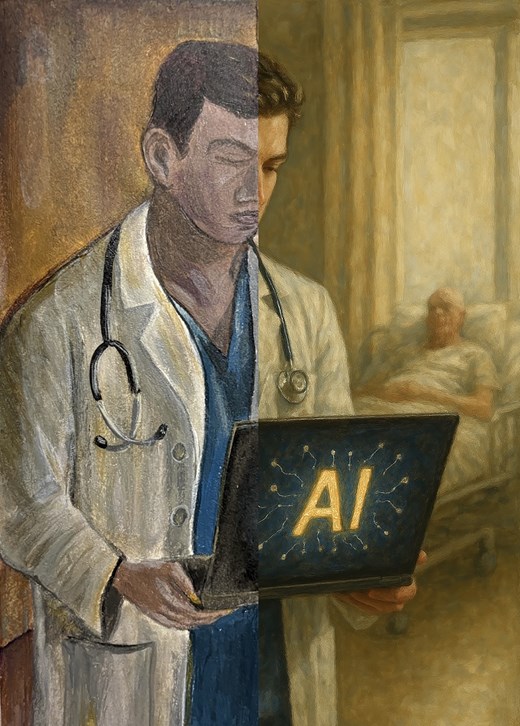
Her most recent work turns outward, toward education and technology. The ATS Scholar piece emerged during her time teaching in the ICU and NICU as a fellow, when she noticed a generational shift among learners. Many had trained almost entirely in a post-COVID environment. “A lot of residents and students had only known that world,” she said.
Her aim was not to argue against technology, but to think carefully about its role. “We should collaborate with technology rather than depend on it,” she said. She has already seen AI-generated images become commonplace in presentations, efficient but flattening. “Before, you had to work with an image to make it fit,” she said. “Now it’s just there.”
Art, for her, resists that ease. It demands attention and tolerates uncertainty. In medicine, that translates to presence—time at the bedside, attention to how patients experience care, and an insistence on staying engaged with the human dimensions of illness. “For the creative and humane part of medicine,” she said, “we have to be careful not to lose that.”
Despite a demanding schedule, she continues to make art, often late at night and in smaller increments than before. Time no longer allows for long, uninterrupted sessions, and her work has adapted accordingly. “Everything I’ve done since residency has been smaller pieces,” she said. She recently began a larger painting and expects it to take time. That feels appropriate.
Asked what she would tell trainees who feel creatively inclined, her advice is practical.Medicine is consuming, and everyone needs something beyond their clinical work. If art matters to you, she suggests, make space for it—but let it change shape. “It’s going to look like a new normal,” she said. Smaller projects. Manageable goals. Continuity over scale.
Art, for Medha, was never a diversion from medicine. It has run alongside it, quietly shaping how she listens, teaches, and practices. It is part of the same work.

Interventional Pulmonary

Tru Freeze

The Interventional Pulmonology division will introduce cryo spray therapy this spring for the treatment of post-transplant airway stenosis. Faculty training is planned for March, with the first case expected in April as the program expands its therapeutic options for complex airway disease

Research

Yolanda Hidalgo-Hernandez secures national grant

Breathing Life Into Detroit: ABIM Foundation Awards Grant for Community COPD Education


When patients with COPD leave the hospital, much of their care shifts quickly into their own hands. Breathing Life Into Detroit begins at that transition point. Led by Yolanda Hidalgo-Hernandez, a Pulmonary and Critical Care Medicine fellow, and Melanie Garbarino, MD, the project’s principal investigator, the study has been awarded a two-year grant from the ABIM Foundation. Henry Ford Hospital was named among eight recipients nationwide.

The project will examine whether structured inhaler teaching after hospital discharge improves care for patients hospitalized with COPD. The study will be randomized and will focus initially on how inhaler instruction is delivered in the home by visiting nurses. Longer-term outcomes, including hospital readmissions, will be evaluated as the program develops.

The study population will include patients admitted to Henry Ford Hospital with COPD, reflecting a setting where transitions of care are frequent and execution matters. By concentrating on inhaler technique, the project evaluates a practical component of care with direct relevance to daily disease management.

The work was developed in collaboration with Amber Martirosov, with mentorship from Drs. Tatem and Jennings. The project reflects a close partnership between fellow-led study design and experienced mentorship.


The award marks an important milestone for Dr. Hidalgo-Hernandez, representing the successful development of a study from concept through national funding — work that positions her to lead future outcomes-focused research in pulmonary medicine.

Yolanda Hidalgo-Hernandez

As Breathing Life Into Detroit moves into its initial phase, the grant supports a focused clinical question: whether targeted inhaler teaching can meaningfully influence outcomes after patients return home.


Rana Awdish’s Work on Medical Language Draws National Attention

Overview

We’re pleased to share recent national recognition of Rana Awdish, whose work has focused on how communication shapes the clinical encounter, particularly during serious illness and recovery. Coverage in The Intima, a profile by Henry Ford Health, and an essay published by the American Medical Association examines her writing and leadership around physician–patient conversations. Together, these pieces highlight a consistent emphasis on word choice, listening, and acknowledgment as practical tools that influence patient experience and clinician well-being.

Across the essays and interviews, Awdish describes communication not as a soft skill but as a clinical responsibility—one that shapes trust, memory, and meaning long after an encounter ends. Her writing draws on personal illness, bedside experience, and institutional work to show how missed or careless language can deepen harm, while deliberate attention to words can help repair it. Rather than offering prescriptions, the pieces focus on awareness, reflection, and small, repeatable changes in how physicians speak and listen in moments that matter most.

Before You Go…

About This Newsletter

This newsletter highlights scholarly, clinical, and creative achievements across the division. To suggest an achievement or recognition for inclusion, please contact Jeff Jennings or Sharon Raymond-Forde.