
- Staffing of these studies will be with the PM checker.
- The PFT fellow will contact the PM checker to let them know and arrange a time to review the studies.
- This information has been created into an Epic dot phrase. You can copy/paste it into one of your own dot phrases by taking it from Michael Lazar’s SmartPhrases: . MHLNOCTURNALOXIMETRYREPORT
Articles to review:
https://www.ncbi.nlm.nih.gov/pmc/articles/PMC5886431
https://pubmed.ncbi.nlm.nih.gov/17646227/
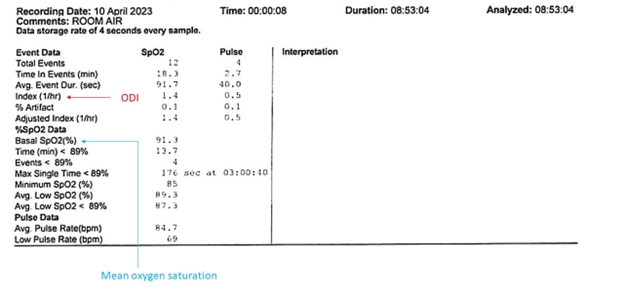
The following is what is in the dot phrase
NOCTURNAL OXIMETRY INTERPRETATION
DURATION
- Duration of the study is < 5 hours. Consider repeating the study if results are non-revealing.
- Duration of the study is ≥ 5 hours
ARTIFACT
- There are no significant breaks/artifact in the saturation waveform.
- There are minor beaks in the saturation waveform consistent with artifact (less than 20% of the total waveform).
- There are major beaks in the saturation waveform consistent with artifact (more than 20% of the total waveform).
MEAN NOCTURNAL SATURATION
- Mean nocturnal saturation is ≥ 92% on room air (within normal limits)
- Mean nocturnal saturation is < 92% on room air. In the absence of untreated sleep apnea and hypoventilation, low mean saturation may indicate underlying cardiopulmonary disease
- Mean nocturnal saturation > 88% on oxygen therapy. In the absence of untreated sleep apnea and hypoventilation, requiring oxygen therapy to maintain adequate saturation suggests underlying cardiopulmonary disease.
- Mean nocturnal saturation ≤ 88% on oxygen therapy; may need to increase oxygen therapy. In the absence of untreated sleep apnea and hypoventilation, requiring oxygen therapy to maintain adequate saturation suggests underlying cardiopulmonary disease.
Please note that oxygen prescription (based upon Medicare criteria) requires a cumulative time of 5 minutes or more with saturation ≤ 88%.
ODI (OXYGEN DESATURATION INDEX)
Defined as defined as the mean number of 4% desaturations or greater divided by recording time (hours).
There is a decreased sensitivity of the ODI in detecting sleep apnea if the study is performed on supplemental oxygen therapy.
- ODI < 10: moderate to severe sleep apnea is less likely but sleep apnea is not excluded and polysomnography (PSG) should be considered if the patient has clinical symptoms of sleep apnea and/or the waveform is suggestive of sleep apnea
- ODI is between 10 and 30: suggests moderate to severe sleep apnea
- ODI is ≥ 30: highly suggestive of moderate to severe sleep apnea
SAWTOOTH PATTERN
This pattern is characteristic of repeated, cyclical desaturation and increases concern for underlying sleep related breathing disorder such as obstructive sleep apnea.
- Is there a sawtooth pattern noted on the oxygen tracing curve? {YES NO:21982}